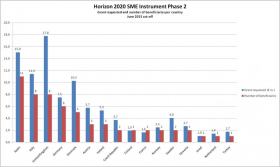
European funding for research activities was envisaged in the first Community Treaties, related to coal and steel and nuclear energy, and was extended in the early 1980s with the establishment of a European framework programme for research. Research policy was subsequently progressively integrated in the Treaties, to become a shared competence between the European Union (EU) and its Member States. European funds for research and innovation activities are distributed between several interlinked EU programmes. For the current period (2014-20), the main programme, Horizon 2020 (the eighth framework programme for research and innovation) is fully dedicated to funding such activities across all policy field.
read moreLatest news
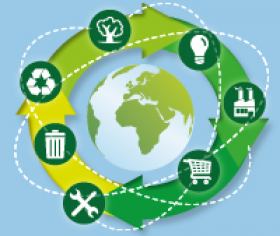
The European Union have revised the Circular Economy package; through this latest Position paper and related actions, BEDA can strengthen its position as the design authority at European Commission level. BEDA has prepared a Position paper on Design and the Circular Economy, led by BCD (Barcelona Centre de Disseny). This paper falls within the revision of the Circular Economy package by the European Commission; it offers a great opportunity for BEDA to strengthen its role as design authority at European level by making relevant recommendations to the EC.
read moreThis publication seeks to provide a key to understanding the complexity, richness and diversity of the examples of territorial cooperation in Europe and illustrating their role in the process of European integration. 2015 marks the 25th anniversary of Interreg, the European Union instrument to promote cross-border, transnational and interregional cooperation.
read moreThis Design Policy Workshop will provide an overview of design support programmes in Europe, present an example programme in more depth and develop a plan for a design support programme and evaluation framework. The half-day workshop is made up of two exercises. The first exercise has been developed to explore the stages of planning, implementing and reviewing design support programmes by working through a series of questions on A1 posters in small groups. As a result of this exercise, workshop participants will have an understanding of how to set up a design support programme. The second exercise will enable public officials to develop an evaluation framework for the programme again using hands on tools.
read moreMore than one third of EU citizens live and work in Europe's border regions. Those borders have a direct and indirect impact on their lives. European Territorial Cooperation (the Interreg programmes) plays an important role in removing border obstacles and fostering cross-border cooperation. Relatively small in budget, the Interreg projects have achieved many concrete outcomes for the citizens – whether in the area of cross-border security, transport, education, energy, health care, training or job creation.
read moreThe Autumn edition of Panorama is now available online, and the lead article details Regional Policy's contribution to the realisation of the EU's new Energy Union package, through increased investments in the low carbon economy and sustainable energy projects. Our other main article shows how the European Structural and Investment Funds will contribute to revitalising the Greek economy. We also highlight the advantages of Smart Specialisation strategies for transforming regional economies.
read moreThe European Commission adopted today a cross border cooperation programme for Greece and Bulgaria which first priority is to boost the competitiveness of SMEs and help them expand beyond local markets. It is worth €129 million, with a contribution from the European Union of more than €110 million from the European Regional Development Fund.
read moreReports from four cities examine the impact of free movement of EU workers at a local level, on the basis of studies conducted in Frankfurt, Leeds, Milan and Rotterdam in 2014/2015.
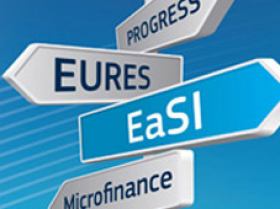
read more2014 was the first implementation year of the European Union Programme for Employment and Social Innovation (EaSI). To ensure a high visibility and to respond to accountability needs, a report has been published on the performance of the EaSI programme, which consists of three axes: the Progress, EURES, and Microfinance and Social Entrepreneurship axis.
read moreManufacturers of construction products who are planning to CE-mark their products or seeking advice on a 'to-do list' now have a useful new tool at their disposal. The guide is available in all EU languages.
read moreEntrepreneurship helps to create jobs and develop skills, and to include the unemployed and disadvantaged in society and the economy. With its contribution to growth and job creation, entrepreneurship and self-employment hold a potential for all groups of the population. Nevertheless, the share of self-employment in total employment differs strongly across population groups. Let's look at the graph below: while the overall share is close to 15%, shares are clearly higher for men and older people, reaching even close to 23% for older male nationals (click to enlarge).
read more Showing page 25 from 53 pages |