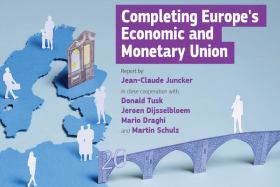
Europe's Economic and Monetary Union (EMU) is in much better shape today than it was before the financial crisis. However, despite progress, particularly as regards reinforcement of the economic governance and the launch of the Banking Union, the EMU remains incomplete. Divergence in economic performance across the euro area is significant. With close to 18 million unemployed and many within our societies exposed to risks of social exclusion, more needs to be done to turn the euro area into a fully robust construction.
Latest news
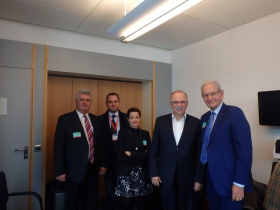
KEPA's delegation, headed by the President Mr. Nikolaos Efthymiadis, participated in "OPEN DAYS 2015", held in Brussels during 12-14 October 2015. KEPA's delegation was consisted of Mr. Nikolaos Efthymiadis - President, Mr. Spyros Skotidas - General Director , Mrs. Angeliki Barakli - Head of European Projects Department and Mr. Neoklis Stamkos - Chief Accountant and Head of KEPA's Microcredit Unit. During their stay in Brussels they held meetings with KEPA's partners and European Union's executives.
read moreThe curtain has come down on the OPEN DAYS 2015. Final registration statistics confirm the attendance of about 6000 (5924) participants, 16% of whom registered on-site. This represents an increase of about 5% comparing to 2014. About two out of three participants came from local, regional, national or EU administrations and three out of four travelled to Brussels specifically for the event. This confirms the same trends as last year.
read more20,000 micro-enterprises will get access to loans worth 237 million euro under the European Programme for Employment and Social Innovation (EaSI). Today, the European Investment Fund (EIF), which manages the EaSI Guarantee on behalf of the European Commission, and six microfinance institutions are signing guarantee agreements that will open up access finance for micro-enterprises. The European Commission will contribute with 17 million euro to the guarantees signed today, which is expected to result in microloans worth 237 million euro.
read moreThe newly elected President of the EESC, Georges Dassis, today met with the First Vice-President of the European Commission, Frans Timmermans. Mr Dassis presented to him the EESC's recommendations for the Commission's 2016 annual Work Programme. Among others, these included accelerated economic integration and convergence, strengthening democracy in the EU, reinforcing the European social model, and establishing a new migration policy.
read moreToday the High Level Group on Simplification, launched by the Commission in July, held its first meeting in Brussels. The chairman of the Group, former Commission Vice-President Siim Kallas and the newly-appointed members met with European Commission Vice-President in charge of the Budget Kristalina Georgieva and Commissioners Corina Crețu and Marianne Thyssen in charge of Regional Policy and Employment, Social Affairs, Skills and Labour Mobility, respectively.
read moreThis more responsible approach responds to new economic realities in line with the EU's foreign policy. Based on three key principles - effectiveness, transparency and values - it ensures trade policy benefits as many people as possible. The Commission is proposing a new trade and investment strategy for the European Union, entitled ‘Trade for All: Towards a more responsible trade and investment policy’. The new approach builds on Europe's excellent trade track record. EU companies export nearly as much as China to the rest of the world and more than firms in the United States or any other country.
read moreThe widening gap between rich and poor is leading to segregation in more and more European cities. The rich and the poor are living at increasing distance from each other, and this can be disastrous for the social stability and competitive power of cities. These are the conclusions of joint research of Prof. Maarten van Ham, ERC grantee at Delft University of Technology, and Prof. Tiit Tammaru, Dr. Szymon Marcińczak and Prof. Sako Musterd.
read more
Spanning seven years (2014 to 2020) and working with a budget of €77 billion, Horizon 2020 is the biggest EU research and innovation funding programme ever. Today, the European Commission adopted the second of its two-year work programmes setting out funding opportunities for 2016-2017. This Work Programme offers a budget of almost €16 billion. It is based on extensive consultation and stakeholder involvement. All the calls and related information are published on a single portal.
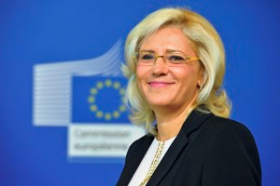
read moreFrom 5 to 8 October, Commissioner for Regional Policy Corina Crețu is in Greece. She meets with Prime Minister Alexis Tsipras, Giorgos Stathakis, Minister of Economy, and with Ministers in charge of EU funds. "This visit will focus on what we, the Commission and the Greek authorities, can do to pave the way for a prosperous future in the country. The contribution of both the European Structural and Investment Funds and of the Investment Plan for Europe to growth and job creation in Greece will be at the heart of my exchanges with national and regional stakeholders."
read moreThe first EU Transnational Cooperation Programme for the “Balkan-Mediterranean”, covering the Balkan Peninsula and the Eastern Mediterranean Sea, was adopted today. Bringing together three EU countries (Greece, Bulgaria and Cyprus) and two candidate countries (Albania and the former Yugoslav Republic of Macedonia), it will focus on two priorities: boosting the competitiveness of the regional economy through entrepreneurship and innovation, and protecting the environment.
read more Showing page 24 from 53 pages |