This Study brings light to the economic factors that contribute to sustainable growth in the European Union (EU) and investigates the political feasibility of economic reforms enhancing such factors. It also explores the aspects influencing competitiveness and fostering convergence and cohesion at EU and Member State levels.
read moreLatest news
Design for Europe is excited to announce that its 2016 summit will be hosted in Tallinn, Estonia, the European hub for cutting-edge innovation and entrepreneurship, on Thursday 6 October. Join us for this free, day-long event that will demonstrate the transformational effect of design within European businesses and governments and provide solutions for future economic growth. Special guests and key speakers will include contributors from the European Commission, policymakers at regional and national levels as well as representatives from business organisations, such as Google, and networks across the design and innovation industries.
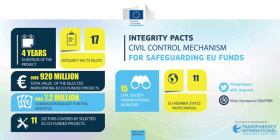
read moreCorruption in public procurement harms the public interest, undermines public trust and has a negative impact on people’s lives. However, tackling effectively corrupt and fraudulent activities is a challenging task and requires a complex approach. Civil society as effective anti-corruption actor can give a valuable input in promoting transparency, accountability and preventing corruption.
read moreThe EU cohesion policy aims to narrow the development gaps and reduce disparities among EU Member States and regions. With a budget of €454 billion for 2014-20, the European Structural and Investment Funds (ESI Funds) are the European Union's main investment policy tool to for supporting job creation and boosting growth.
read moreThis week, the European Association of Guarantee Institutions (AECM) is organising its annual general assembly combined with a seminar on the transfer of businesses, followed by a global summit of SME guarantee organisation leaders. This three-day event in Porto brings together AECM members and policy makers from around the globe to discuss the European and global situation of SME's access to finance and the specific role that guarantee institutions play.
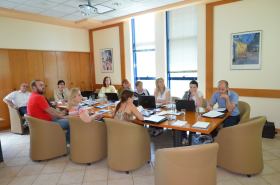
read moreEISS project peer-learning workshop took place in KEPA’s premises (leader partner) in Thessaloniki, from 13th to 16th June. This 4-day workshop aimed at exchanging expertise among the three partners (KEPA – Greece, Friuli Innovazione – Italy & NORRIA – Hungary), concerning the collaboratively address of a common innovation support challenge.
read moreGlobal Covenant of Mayors for Climate & Energy will combine efforts and leadership to accelerate climate action at the local level worldwide. The world’s two primary city-led climate change and energy initiatives, the EU Covenant of Mayors and the Compact of Mayors, announced the formation of a new, first-of-its-kind global initiative of cities and local governments leading in the fight against climate change.
read moreToday the High Level Group on Simplification is meeting in Brussels to discuss the issue of gold-plating in the access to and management of the European Structural and Investment (ESI) Funds. "Gold-plating" refers to the administrative extra-requirements added by the national and local authorities in charge of managing the funds and imposed to the beneficiaries.
read moreAs part of the Skills Agenda for Europe, the Commission has published an 'Entrepreneurship Competence Framework' to raise consensus about what entrepreneurship skills are. The development of the entrepreneurial capacity of European citizens and organisations is one of the key policy objectives for the EU and Member States. The Entrepreneurship Competence Framework (EntreComp) proposes a shared definition of entrepreneurship as a competence and aims to establish a bridge between education and work.
read moreEuropean Commission has published a public consultation on the possible revision of the Mutual Recognition Regulation (EC) No 764/2008 applying in the field of the free movement of goods. If a business is lawfully selling a product in one EU country, it should be able to sell it in other EU countries without adapting it to the national rules of that country, even when there are no common European rules on how the product has to be manufactured (i.e. rules on the characteristics of the product, its size, composition, etc.).
read moreThis book brings together some of the key conceptual insights behind the "Three Os" and highlights actions that are already taking place or are being prepared at time of publication in May 2016. It is hoped that the ideas and initiatives described in the book will stimulate anyone interested in European research and innovation.
read moreThe 2016 event, hosted by CyIDA in Limassol, Cyprus, was attended by representatives from twenty five member organisations. The BEDA Strategic Policy Plan 2021 is now in its second year; as a means of conveying its five strategic objectives, the organisation has launched a new manifesto, setting out its plans to 2021. Having begun with ‘structure’, BEDA is now in the second phase of its Design Europe 2021 project – ‘populate’.
read more Showing page 12 from 53 pages |